Chapters About the Author Blog Events/News Green Burial FAQ Reviews Buy the Book Contact

Friday, May 11, 2007

Good Green Burial Media


I’m back to the blog after a spate of deadline reporting and travel, the latter of which will inspire a number of upcoming entries in this space (next week: a re-enactment of Abraham Lincoln's funeral and how Abe's passing 142 years ago connects to the natural burial movement of the Cyberage). In the meantime, I thought I'd share some of the better, recent press about natural burial.


The first is an interview with Terry Gross, on her NPR show, Fresh Air. In brief periods when construction workers next to the studio had laid down their jackhammers, Terry gamely led a wide-ranging discussion on the costs of modern memorialization and the merits -- and challenges -- of green burial. To listen, click here and follow the link.


I'd not heard of the California Literary Review until the editor e-mailed me with his request for an interview. Turns out CLR is a lively, compelling on-line arts journal, and in keeping with the publication, Paul Comstock's questions were direct and intriguing, making for one of the better, brief overviews of what the green burial movement is all about. Click here to read it.

Back next time with Abe and more about the re-enactment of his funeral, as seen in this picture above.

Thursday, March 15, 2007

Connecting with Natural Burialists Near You


I'm still gathering information from local hospitals about a family's right to reclaim their deceased and bring them home (or to the crematory). Apparently, so few -- if any -- families make this request that none of the administrators I spoke to had any idea how their doctors were supposed to respond to it. As far as they know, no hospital policy on the issue exists. The administrators promise to look into the matter further and get back.

In the meantime, I'll turn to addressing the question I'm asked most often: is anyone else in my area interested in starting a natural cemetery? The question comes up frequently enough that I've created a database of names/contacts and have started putting people from the same general region in touch with each other.

I'm happy to add your name to the list. When someone from your region writes in, I'll forward on your name and whatever contact information you care to share.

Here's the list to date, by state/region:

California (Humboldt County, Los Padres National Forest)

Colorado (Denver area)

Connecticut

Georgia (Central part of the state, Savannah)

Indiana (Bloomington)

Kentucky (Lexington)

Maine (Orrington, Solon)

Ohio (Cleveland)

Pennsylvania (Bucks County, Lehigh Valley, Philadelphia)

Virginia (Roanoke)

Add to this list the score of groups that already exist in the following states: Texas (Austin), greater Midwest (group based in Wisconsin), New York (Tarrytown), as well as Canada (Ontario and British Columbia), among others.

I'm in the process of putting together a short primer on how to go about getting a natural cemetery off -- or on -- the ground. I'll post that at a later date.

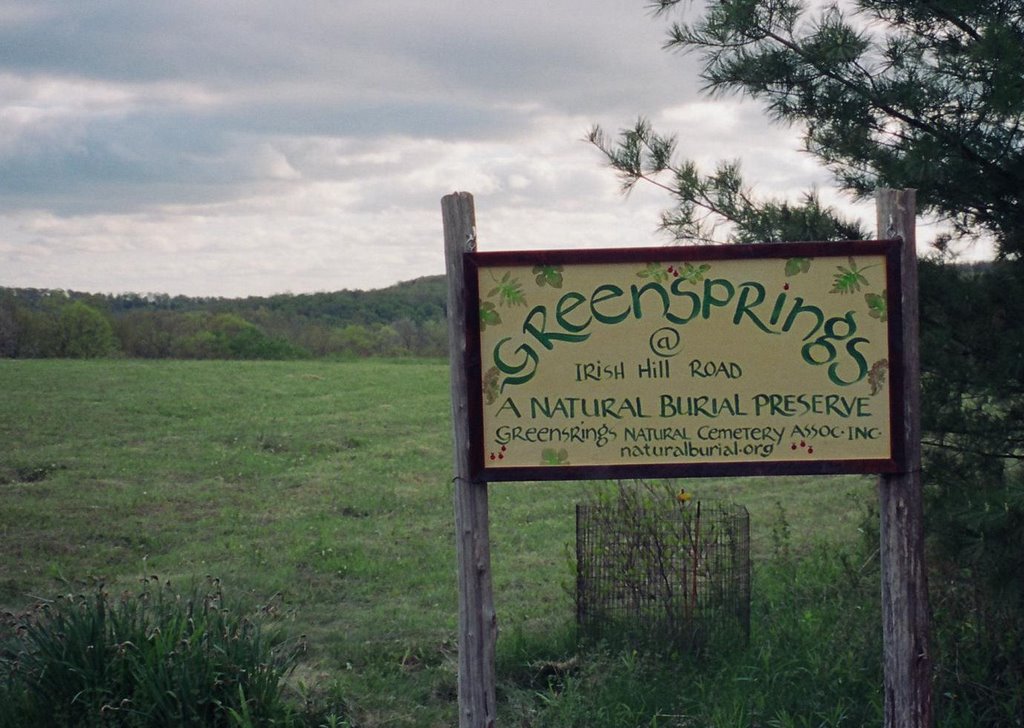
Note on the photograph: This is the entrance to the Greensprings Natural Cemetery Preserve, outside Ithaca, New York.

Friday, February 23, 2007

Planning for Your Own Natural Return


When I set out to write Grave Matters, I imagined a future reader handing the finished book to her family and saying, "When I die, do chapter [fill in the blank]."

I consequently laid out the book in what I hope is a fairly straightforward arrangement. Each chapter presents a picture of a greener, more natural alternative to the standard funeral home send-off, as experienced by a real family in a real place. An appendix offers a brief how-to, with enough information to help readers pursue the given alt.burial strategy when the time comes.

Still, I'm under no illusion that arranging your own future green burial is as simple as handing over the book to a loved one, with a bookmark stuck in the relevant chapter. Funerary laws vary from state to state, region to region. The backyard burial that's possible in the county I examine in the book may be illegal in yours. When an expected death occurs at home, your municipality may demand more than the hospice nurse's declaration to that effect when issuing a permit that allows you to transport the body to the crematory or cemetery.

Your family, who will be in charge of overseeing your final arrangements, will need concrete, site-specific information that's beyond the reach of the book. They'll need to know, for example, the best, local crematory to use and just where to turn to buy a cardboard coffin. Whom, exactly, should they contact to arrange the scattering of your ashes at sea? If you die in the hospital, what paperwork do they need in order to transport your body back to the house for the home funeral?

And, by the way, where's the will that states your preference for your green burial of choice? Some hospitals, after all, will only release your body to family members if you've indicated that in a living will or other pertinent document. Otherwise, the funeral director gets involved.

Your family can probably come up with the answers to those and the host of others that arise with death comes calling. But you can save them no small effort and even greater anxiety -- and guarantee that the green burial you want comes about as you envision it -- if you plan for it yourself.

What does that mean exactly?

In the coming weeks we'll look into question. I'll use this space to craft a plan a family could use to conduct a natural burial in this corner of the planet. The information I glean, which I'll post, will be specific to this locale, of course. But the questions I ask -- if not the specific answers -- are the very ones you'll have to consider for yourself and your family. At the very least, I hope the exercise I conduct here inspires you to undertake a similar one in the place you call home.

Next week: Checking in with the local hospital.

And speaking of hospitals: In the course of searching for funeral images of Abraham Lincoln, who was embalmed and subsequently viewed by some million mourners, I came across this Civil War-era photo of the Douglas Hospital in Washington, D.C. Source: Library of Congress.

Friday, February 16, 2007

Yanking Teeth Before the Final Burn?


After learning that the major air pollutant billowing from crematory smokestacks consists of mercury that taints the dental amalgams/fillings of the deceased, a number of readers have written to ask the logical question: Why not yank riddled teeth from the dead before loading them into the hearth?

Pulling those teeth would, of course, prove an immediate boon to the environment, preventing their cache of mercury from eventually contaminating soil and surface waters. It could also be done cheaply and easily, by, say, a dentist or cremator. The latter, after all, sometimes doubles as a funeral director who, as a matter of course, may himself remove pacemakers from the deceased's chest prior to cremation.

The strategy would, at the very least, cost significantly less than outfitting cremation units with mercury-scrubbing filtering equipment, an option that can run to the hundreds of thousands of dollars.

Targeting teeth is a sensible enough idea, in fact, that legislators, environmentalists and the cremation industry itself have all considered it. A government agency in Sweden, a country with a 70% cremation rate, proposed the practice back in 2004. On this side of the Atlantic, the state legislature of Maine recently debated a bill that would require crematory operators to remove their deceased's mercury fillings (or install mercury filters).

Like many logical proposals, however, this one held little appeal to human sensibilities. That Maine bill, for example, promptly died because funeral directors said they didn't want to engage in pulling teeth from cadavers, in part because they found the act both "repulsive" for themselves and potentially stressful to grieving family members. Cremators, on the other hand, contended that laws prohibit them from "tampering" with bodies in their care.

All legitimate reasons, certainly, though ones that do nothing to actually solve the very real threat mercury deposition from crematoria poses to the environment -- and, ultimately, to the health of the living.

Which leaves us with mercury filters, a technology, as I wrote earlier, I believe will come to crematory smokestacks. In the meantime, each of us can take a few steps now to ensure a green send-off later. One idea comes from those Maine legislators: include a provision in your will that allows your mercury-laden teeth to be removed prior to cremation. Another is even more obvious: the next time you have a cavity, ask your dentist to pack it with a composite -- mercury free -- filling.

Subscribe Now: Feed Icon

Grave Matters

Facebook page for the book on green burial, Grave Matters, with updates on the growing movement.

Followers